
Guinea-Bissau
Republic of Guinea-Bissau
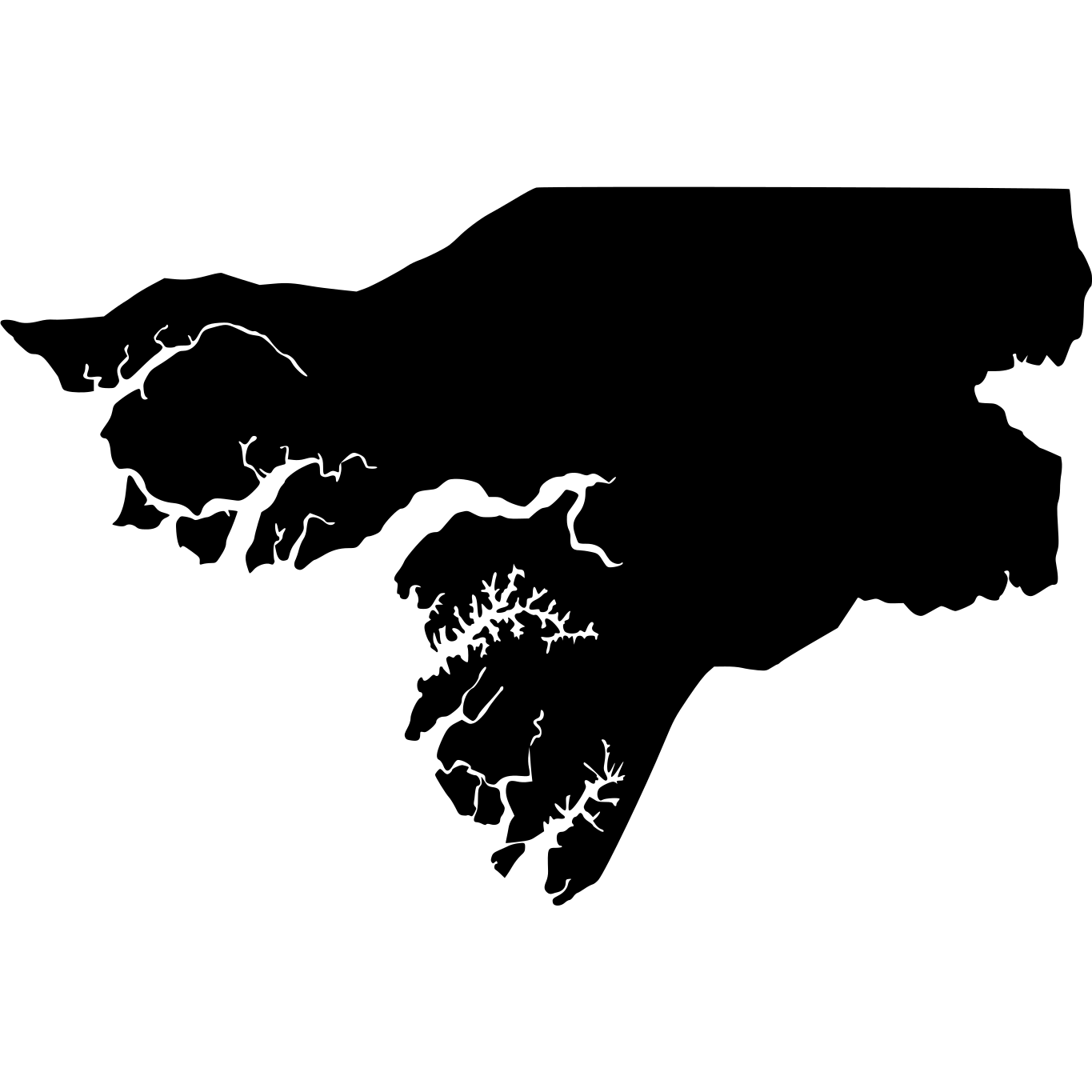
Guinea-Bissau is one of the world's poorest countries, heavily dependent on cashew nut production and exports (world's fifth-largest producer). Cashew accounts for over 90% of export revenue. The economy also depends on fishing, rice cultivation, and timber. Political instability (multiple coups) has hindered development. The country operates within the CFA franc zone (WAEMU), providing currency stability. Offshore oil and gas potential exists but remains unexplored. Challenges include poverty, weak institutions, drug trafficking concerns, and extremely limited infrastructure.
Snapshot
World Bank Indicators Compare with another country
Climate Readiness Full ranking
How this is computed
Adaptive capacity to absorb climate finance and adapt, following the readiness dimension of the ND-GAIN framework. Built only from measured values already held on each country profile. It is not a measure of emissions or physical climate vulnerability, which the platform does not yet hold.
- Energy access (30%) — World Bank, access to electricity (% of population). The single most climate and energy specific signal held: SDG 7 and the clean-energy transition.
- Governance readiness (20%) — Transparency International, Corruption Perceptions Index (0-100). ND-GAIN governance readiness: the capacity to govern and deploy climate finance. Higher is cleaner.
- Human readiness (20%) — UNDP, Human Development Index (0-1). ND-GAIN social readiness: the adaptive capacity of the population.
- Economic readiness (15%) — World Bank, GDP per capita (current US$), latest measured year. ND-GAIN economic readiness: the capacity to finance adaptation. Scored relative to the covered set.
- Digital readiness (15%) — World Bank, individuals using the Internet (% of population). Information systems for early warning and adaptation.
A country is scored only when at least 4 of the five indicators are held. Sub-scores are weighted and renormalised over the indicators that are present; nothing is estimated for one that is absent.
Country Facts
Focus Sectors
Regulations & Taxes
Business Directory (118)
View AllESCOLA DE CONDUÇÃO MODERNA
BusinessEURO OFFICE
BusinessRENLUV-GC/GB - REDE NACIONAL DE LUTA CONTRA VIOLÊNCIA BASEADA NO GÉNERO E CRIANÇA NA GUINÉ-BISSAU
BusinessPAPELARIA ALVALADE SARL
BusinessAKIL TELECOM BISSAU SARL
BusinessNO JUMBAI
BusinessCFAO-GB
BusinessSCINDI, SARL
BusinessMENCOR, LDA
BusinessPASTEL
BusinessADULAI BADORA SARL
BusinessSOLUTIONSCO SARL
BusinessTenders
View AllRepublication-Study on the Electrification and Optimization of the Electrical System at the Simão Mendes National Hospital (HNSM)
WHO
Recrutement d´une entreprise pour les travaux de la réhabilitation et extension du réseau électrique Moyenne et Basse Tension à Bissau.
Projet d Urgence pour l Amelioration des Services de l eau et l' Electricite
Contract Awards
View AllDesenvolver conteúdos para o Passaporte de Aprendizagem da Guiné-Bissau.
Government of Guinea-Bissau (World Bank-financed, project P179509)
Contratação de um gabinete de consultoria para desenvolver um aplicativo de Seguimento da Presença dos Professores e Recursos
Government of Guinea-Bissau (World Bank-financed, project P179509)
Recrutement d'un spécialiste en suivi /suivi et évaluation pour le PCH
Government of Guinea-Bissau (World Bank-financed, project P179509)
Aquisição e instalação de equipamentos informático para a UICV e a UIT, no âmbito do Projeto Capital Humano (PCH)
Government of Guinea-Bissau (World Bank-financed, project P179509)